



AI chatbots have rapidly evolved from mere "nice to have" innovations to integral parts of contemporary digital infrastructure. Whether in customer service, lead qualification, internal processes, or knowledge management, companies are now looking toward AI chatbots to increase productivity and facilitate interactions.

However, amid all the talk about chatbots, their implementation is often flawed. They might provide superficial automation or turn out to be complicated, pricey, and hard to manage.
This piece sheds light on the practicalities of implementing AI chatbots successfully, areas where they prove highly beneficial, and reasons to keep expectations and expenditures in check.
What AI Chatbot Implementation Really Means
The use of a chatbot does not simply mean implementing a chatbot on your web or internal site for your users. A chatbot requires you to design a system that is able to understand context and help users.
At the most basic end of the spectrum, a chatbot will be able to:
- answer frequently asked questions
- walk users through simple procedures
- gather information and present it
On a more sophisticated level, a chatbot will:
- communicate and interact with your internal systems (your CRM, ERP and databases)
- start work processes and initiate automated procedures
- aid in decision making by providing insight into context
- serve as the interface for complex business processes
The important distinction here lies in the depth.
Where AI Chatbots Actually Create Value
AI chatbots work best when there is a lot of repetitive communication in a system.
Customer support
Chatbots can immediately resolve standard queries, thus freeing up support staff for more intricate issues.
Lead qualification and sales
Chatbots can gather data, ask specific questions, and qualify leads according to predetermined parameters, thus streamlining the process of converting prospects into sales.
Internal communication
Employees can leverage chatbots to get information, send requests, or initiate workflows without having to go through multiple interfaces.
Knowledge management
Chatbots can synthesize information from various documents, extract essential facts, and even offer quick answers drawn from an organization's internal databases.
In each scenario, the intention is not to eliminate human labor — rather, to minimize repetitive tasks.
AI Does Not Replace Teams — It Extends Them
Among the most widespread myths about chatbot technology is that it could replace entire teams of people completely. Actually, this is seldom the case, and it's usually undesirable.
For instance, artificial intelligence works well when doing things like:
- performing repetitive and predictable tasks
- dealing with structured dialogue
- working on the initial stage of interaction
Humans play their crucial role in:
- problem-solving of any kind
- relational and emotional aspects of communication
- decision-making
- handling exceptions and ambiguities
The most successful examples of implementation use chatbots as an initial level of interaction rather than as the ultimate one. In this way, they streamline workflow but don't make any critical decisions.
As a result, the combination of human and AI interaction delivers:
- quicker responses
- less load on the team
- more consistent communication
- better experience for users
In other words, there are still many tasks that should be done by humans.
The Non-Linear Reality of AI Scaling
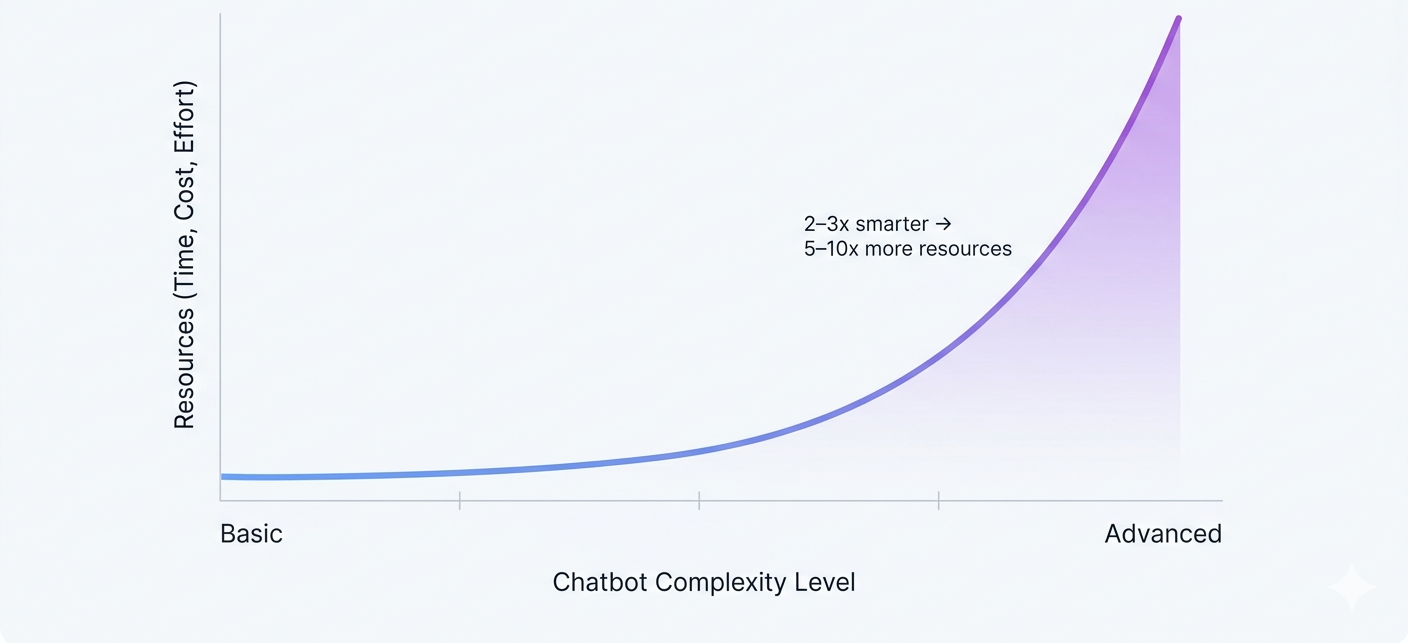
The aspect of scalability in implementing AI chatbots is often underestimated, and this has to do with costs.
Initially, the concept appears fairly intuitive: a basic chatbot can be quickly set up and used to achieve quick results – answering FAQs, offloading the workload from the support team, etc.
As the needs change, however, the complexity of development and maintenance increases substantially.
Adding such functionality demands exponentially more resources:
- greater integration with company systems
- context awareness
- complex workflows
- personalization
- continuous learning and optimization
Thus, a product that can be said to be 2-3 times better than a basic one may end up requiring 5-10 times more effort and resources to create and maintain.
At the same time, the cost does not scale proportionally either — each new layer of capability significantly increases not only the effort, but also the overall investment required to build, run, and sustain the system.

Why so?
Because with each layer of functionality comes:
- a greater number of integrations needed
- more complexity of logic and scenarios
- higher demand for data quality
- need for ongoing training and monitoring
And that's often where things go wrong — not due to poor technical execution, but because of excessive expectations.
Key Challenges in AI Chatbot Implementation
1. Undefined use cases
Building a chatbot for “all situations” results in inconsistent logic and ineffective execution. Focus is key.
2. Insufficient quality of the data used
An AI chatbot relies on well-structured and accurate data. Otherwise, its answers will be irrelevant.
3. Low system integration capabilities
If the chatbot does not have the ability to access and modify business data, its value decreases.
4. Excessive automation
Taking humans out of the equation completely frequently results in bad user experiences.
5. Neglecting maintenance
AI systems require ongoing updates, monitoring, and optimization.
How to Approach Implementation Strategically
An AI chatbot success story does not happen overnight. There are steps involved.
Begin with a defined, narrow purpose
Identify an exact issue that will generate results — such as minimizing the number of support queries or automating internal inquiries.
Enable teamwork rather than substitution
Make sure that there is a smooth transition from the AI to the human team.
Pay attention to integration from the beginning
The power of a chatbot is unleashed only when it connects with other systems within the business.
Think about scale in the design process
Although the chatbot may be simple initially, plan its construction in a manner that allows scaling without reconstruction.
Continuously improve
Monitor performance, collect feedback, and refine the system over time.
Compliance, Trust, and Ethical Considerations
The increasing use of AI in various business processes raises issues related to transparency, trust, and compliance.
There are laws that affect the way in which businesses implement AI systems – particularly when those systems are in direct contact with consumers. It is good practice to familiarize yourself with their requirements, especially if you deal with the European Union market (take a look at our LinkedIn pages on the EU AI Act).
Transparency is essential in any interaction between consumers and AI. Consumers must be aware that they are dealing with an AI system and not a person, and that the design of the system should prevent biased, misleading, or manipulative behaviors.
These topics have been discussed in detail in our article on the ethical aspect of using AI.
What Successful AI Chatbot Implementation Looks Like
In reality, chatbots that have proven to be effective share certain features:
- They address a particular business issue
- They are incorporated into existing processes and systems
- They work in tandem with human employees, but do not replace them
- They can scale as needed
- They constantly develop
But what matters most is that chatbots are perceived as an aspect of an overall operational strategy.
Conclusion
Indeed, AI-powered chatbots have a lot of potential in terms of creating value for the business — but only if their implementation is done with an understanding of what they can and cannot do.
Firstly, they do not serve as some sort of magic solution for achieving complete automation or substituting entire working teams. On the contrary, the chatbot becomes another important layer of acceleration, efficiency, and structure within processes.
Additionally, it is crucial to realize that scaling up the capabilities of an AI is not a linear process. When a chatbot gets more sophisticated, the resources necessary for developing and optimizing it will be needed significantly more than before. Any minor changes may imply added complexity and thus a greater cost of development.
Thus, it is possible to state that AI bots, when applied correctly, become a key part of modern companies' workflow.
If you are seeking to integrate AI in a useful and strategic way, feel free to take advantage of our Artificial Intelligence services.